Physical Address
304 North Cardinal St.
Dorchester Center, MA 02124
Physical Address
304 North Cardinal St.
Dorchester Center, MA 02124
Hand-embroidered flowers never go out of style. From lazy daisy tees to 3D hoop art that sells on Etsy for $45, floral embroidery is the most searched embroidery topic for a reason: it’s beginner-friendly, endlessly customizable, and incredibly photogenic.
This deep guide covers every keyword you searched: embroidery flowers pattern, ideas, easy, tutorial, designs, for beginners, simple, pattern templates, diy, stitches, and pattern design. Inspired by top resources like Pumora’s 16-stitch flower school, Crewel Ghoul’s 17 flower stitches, and LoveCrafts’ 5 simple ways, but rewritten as one organized start-to-finish system you can actually follow.
Level: Absolute beginner to confident beginner
Time: 20 min for first daisy, 2-3 hours for full hoop
What you’ll learn: 10 core flower stitches + 5 complete flower tutorials + free template method + design your own patterns

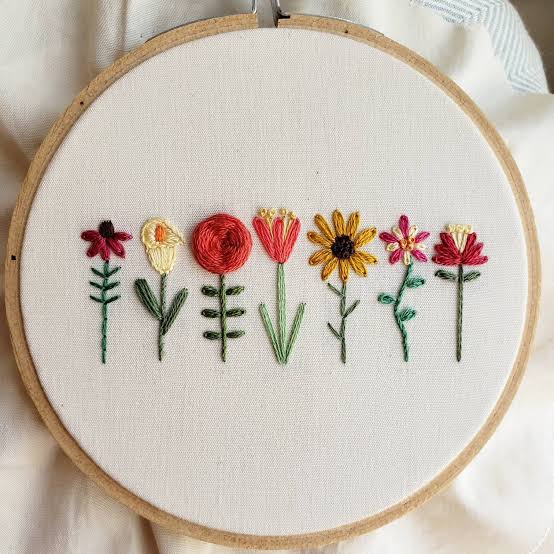
Colorful floral hoop inspiration – photo via Pexels, free commercial use.
Google “embroidery flowers ideas” and you’ll get 100M results, but most are just pretty pictures. Here are practical uses ranked by beginner-friendliness:
Easiest wins (first weekend):
Pinterest / gift winners:
Sellable DIY:
Sets of 3 mini 3-inch hoops sell best. Daisies in white + yellow test highest click-through because they read clearly in thumbnails.

Simple daisy hoop – perfect first project – photo via Pexels.
Flowers work because you can start super simple (5 lazy daisy loops = flower) and grow to realism (thread painting with long & short stitch) without learning entirely new tools.
Don’t overbuy. This $25 kit handles every tutorial below:
Thread tip from top blogs: shorter = better. Cut 18 inches max. Long thread twists, knots, and dulls your petals.
“Embroidery flowers pattern templates” is a huge search because beginners fear drawing. Use these:
1. Trace with lightbox / window (easiest):
Print simple outline (circle center + 5 oval petals). Tape to window, tape fabric over, trace with water-soluble pen. Works for cotton.
2. Stick & Stitch stabilizer:
Print design on Sulky Stick & Stitch, stick on fabric, stitch through it, wash away. Best for dark denim and T-shirts. No tracing reversed.
3. Freehand dots method for simple flowers:
Don’t print at all. Mark a dot for center, draw 5 dots in circle for petal tips. Connect. This is how you get confident fast and design your own.
Free template starter you can draw in 1 minute:
Save any Pinterest line drawing as reference, but redraw simplified – you only need outer shapes, stitching adds detail.

Your setup can be this simple – hoop, fabric, marker – photo via Pexels.
You don’t need 100 stitches. These 10 make 95% of flower designs:
For petals (flat):
For 3D / textured flowers:
6. Woven Wheel – 5 spokes + weave over/under in circle. Instant rose. Fluffier with 4-6 strands.
7. French Knot – wrap 2x around needle, go down beside entry. Centers, baby’s breath, tiny buds.
8. Colonial Knot – figure-8 wrap, neater than French, doesn’t come undone. Great for beginners who struggle with French knots.
9. Bullion / Cast-On – long wrapped tube. Group 5-6 for rose buds, single for lavender buds.
10. Woven Picot – woven triangle on a pin that stands off fabric. Wild 3D petals for statement flowers.
For stems & leaves:
Stem stitch, split stitch, backstitch, straight stitch. Stem stitch (twisted rope line) is prettiest for curvy stems. Split stitch is best under satin because it creates a padded edge.
Start order: lazy daisy → French knot → stem stitch → satin → woven wheel. Master those 5 and you can stitch the entire meadow below.
Time: 20 min. Threads: 2 strands white petals, 2 strands yellow center.
Fix: If petals twist, you pulled loop off-grain. Lay thread with fingertip before tacking. If center sinks, add a tiny straight stitch pad underneath first.
This is the “embroidery flowers easy / simple / for beginners” answer – if you only learn one, learn this.

Daisy hoops make perfect gifts – photo via Pexels.
Time: 30 min. Perfect filler between big flowers.
Stems: stem stitch green, 2 strands, 6cm curvy lines.
Leaves: 2 lazy daisies green at stem middle, slightly smaller.
Flower head: cluster of 5-7 French knots (yellow + white mix) at stem top, 2 wraps each. Vary wraps 1-3 for size variation.
Second variation: straight stitch star – 5 straight 8mm stitches meeting in center, French knot center.
Design trick from SewGuide: mix heights – tall 6cm, medium 4cm, short 2.5cm – instantly looks like a meadow not a row.
Time: 25 min per rose. Use 4 strands pink for learning (thicker = easier weaving).
Color design: two-tone rose – do 3 rounds pink, 2 rounds lighter pink edge. Looks ombre with zero blending skill.
Add 3 small buds nearby: 1 bullion knot green calyx + 1 pink colonial knot bud.
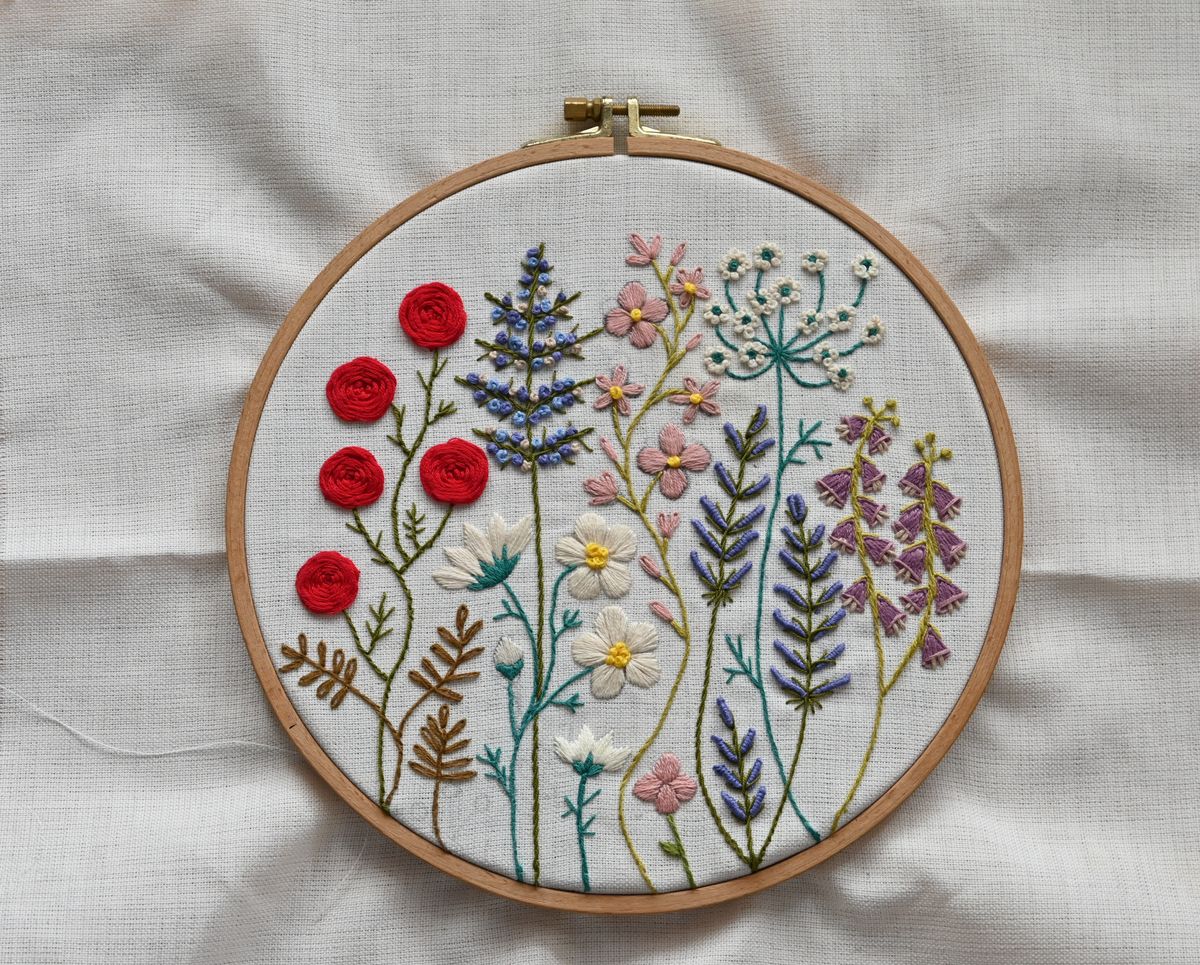
Woven roses + mixed stitches – photo via Pexels.
Easiest realistic flower, huge impact.
Stalk: stem stitch green 8cm.
Buds: French knots purple (3 strands, 2 wraps) alternating left-right up top 4cm, getting smaller toward tip (switch to 2 strands).
Leaves: blanket stitch – draw leaf, blanket stitch one side up to tip, down other side. Or simpler: fishbone – overlapping straight stitches.
Make 3 stalks of different heights tied with a tiny bow (backstitch bow). Instant farmhouse hoop.
Slightly advanced but best “wow” for effort.
Center: fill 2.5cm circle with French knots brown / dark orange (dense, 40+ knots) OR satin stitch base + knots on top for padding.
Petals: 12-14 petals around, each 2.5cm x 1cm. Outline in split stitch, fill with long & short: row 1 dark gold at base (long/short varied), row 2 medium gold overlapping, row 3 light yellow tip. Angle stitches toward tip.
Leaves: satin green with center vein straight stitch.
Don’t aim for perfect blending first try – even 2 colors looks great in photos.

Sunflower hoop – long & short petals + knot center – photo via Pexels.
Copy-paste prompts for your next pattern templates:
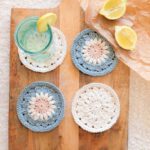
Photograph each on white wood with hoop + thread + scissors – same flat-lay formula that works for crochet coasters.

Hold it up for scale – great Etsy thumbnail – photo via Pexels.
This turns you from copier to creator (and Pinterest traffic magnet):
Offer free black-and-white outline + sell full color + stitch guide – classic funnel used by Cutesy Crafts, DMC, Mindful Mantra.
From hundreds of beginner comments:
Block finished hoop: mist back with water, press face-down on towel, let dry in hoop – crisp for photos.
What is the easiest embroidery flower for beginners?
Lazy daisy with French knot center – 5 loops + 3 knots, 20 minutes, 2 stitches.
What stitches do I need for embroidery flowers?
Lazy daisy, French knot, stem stitch, satin stitch, woven wheel. Those 5 cover simple to 3D roses.
Where can I find free flower pattern templates?
DMC free patterns, Pumora free meadow PDF, Crewel Ghoul free traceables, LoveCrafts free collection. Or draw dot method in Section 3 – faster than printing.
What fabric is best for simple flower embroidery?
Cotton or linen, light color, medium weave. Avoid stretch, dark, or loose burlap for first projects.
How many strands for flowers?
2 strands for petals/outlines (neat), 3-4 for centers/knots (puffy), 4-6 for woven roses (full). Test swatch first.
Can I embroider flowers on clothes DIY?
Yes – use Stick & Stitch stabilizer on denim/tees, 2-3 strands, small designs (<7cm) so they survive washing. Wash inside-out cold.
How do I make flowers look 3D?
Woven wheel, turkey work trim, woven picot, or layer: satin base + knots on top + longer center petals.
How long does a floral hoop take?
Single daisy 20 min, 4-inch 3-flower hoop 2-3 hours, full 7-inch meadow weekend project.
You now have the full keyword map: easy starter (daisy), simple fillers (knots), tutorial path (5 flowers), designs library (12 ideas), pattern templates method, stitches reference, DIY applications, and pattern design system.
Week plan:
Day 1 – 5 lazy daisies sampler
Day 2 – French knot meadow + stems
Day 3 – 3 woven roses + leaves
Day 4 – Combine into name hoop, photograph vertical 1000×1500 for Pinterest
Pair this post with our crochet flower coasters guide – crochet the base, embroider the center – unique mixed-media set no one else sells.
Happy stitching – tag your first hoop!
Original guide synthesizing best practices from Pumora, Crewel Ghoul, LoveCrafts, SewGuide. All tutorials rewritten. US terms.